
In This Story

Despite many losses, humanity was able to get through the COVID-19 pandemic. But if we are to experience yet another outbreak on a global scale, how good is our pandemic readiness? David Ramadan and his guest co-host Gregory Koblentz sit down with renowned epidemiologist Michael Osterholm to discuss how the world should prepare to ensure that the next pandemic will not catch us off guard. They pinpoint the shortcomings of the COVID-19 response, particularly with vaccine integrity and lockdown implementation. They also explore how to address the massive problem of “infodemic,” as well as how young people can make a stand against misinformation and disinformation.
Listen to the podcast here:
Improving Pandemic Readiness With Michael Osterholm And Gregory Koblentz
Our guest is a real-life medical detective, and this conversation hits hard. A Manhattan Project-style overhaul of pandemic preparedness, why lockdowns do not work, and what should have been done instead, Joe Rogan's Podcast, and the sobering truth about whether more lives are lost to microbes or to war.
Stay with us. This one is packed. Our topic, pandemic readiness, Vaccine Integrity, and global health security. Few people are better suited to lead that conversation than our guest, Dr. Michael Osterholm. He is a globally recognized epidemiologist, Regents Professor at the University of Minnesota, and Director of the Center of Infectious Disease Research and Policy, CIDRAP.
He has advised the CDC, the US Department of Health and Human Services, the World Health Organization, and even served as a science envoy for health security at the US State Department. His new book, The Big One: How We Must Prepare for Future Deadly Pandemics, confronts the question we all should be asking. What if the next outbreak is worse than the last? Joining me as co-host is my colleague, Dr. Gregory Koblentz, Associate Professor and Director of the Schar School's Bio Defense Graduate Program.
Gregory is one of the country's foremost experts at the intersection of health, science, and security. He has briefed the UN Security Council on bioweapons threats and leads the Global Biolabs Initiative, tracking the world's highest security labs. Together, we will unpack what we have learned and have not since COVID, what the real risks ahead look like, and what it takes to ensure the next pandemic does not catch us off guard.

How Michael’s Career Path Led To The Creation Of CIDRAP
Gentlemen, welcome. Let us start with segment one, setting up the stage. How does science meet security? Michael, briefly walk us through your career path and how it led to the creation of CIDRAP.
First of all, let me just say that I was very fortunate as a young boy to have in my life a woman in this small Iowa farm town that I was born and raised in, who actually subscribed to the New Yorker. She was probably the only person in all of Iowa at the time who subscribed to the New Yorker, and she did.
Included in the New Yorker from time to time was an article series called Annals of Medicine, which was by Burton Rogers, the famous author who wrote a number of interesting stories that were all about disease investigations that the Communicable Disease Center had done. It was a whodunit mystery issue. I read that first one when I was in eighth grade. I knew at that point I wanted to be a medical detective.
Literally from eighth grade on, I have spent my life living out that very dream. I graduated from a small private college in Iowa. At the time when I graduated, I got called into the office of the professor who headed up political science, chastising me for not having filed my topic for my senior paper. I said, “What do you mean? I am a biology major.”
He said, “You have enough credits to be a political science major.” That was maybe the first shot across the bow to remind me that my career is probably going to be a mixture of both the politics of science and the science of politics. From that, I went to the University of Minnesota after graduating. I have been there now for 1975, 50 years. I have been affiliated with the University of Minnesota.

At the time, I was in infectious disease Epidemiology, many people wondered why, because it was going to the horse and buggy years. At that point, we had really solved all the big problems. As you can see, we have not. I started as a graduate student at the University of Minnesota. I also began as an intern at the Minnesota Department of Health. I stayed there for 25 years, eventually taking over the infectious disease area and building it into what it eventually became.
The entire time I was at the University of Minnesota, I was still there. With all of that activity, I also took on a number of other tasks. For example, I have had a formal role in every presidential administration dating back to Ronald Reagan, where I was part of involved with helping to support the HIV AIDS Commission at that time.
Every administration since then, I served under Trump. I was a science envoy for the State Department, traveling around the world to better prepare our country for an eventual pandemic, which did come two years later and much, much better prepared. I was on the Biden-Harris transition team and the COVID. I really had, you might say, a politically agnostic career.
I served two democratic governors, two Republican governors, as we affectionately say in Minnesota, with Jesse Ventura, one independent wrestler, as governors. No one can tell you my partisan politics. I have always just been a private in the public health army, trying to do my job. From that standpoint, I have always seen the relationship between public policy, science, research, and policy, which, of course, CIDRAP is so well named for.
Thank you for that service. Thank you for that independence. We need more of that, especially during the polarized times that we are living in. I just found from your first couple of sentences, the title that I am going to use for you, even though you have probably 20 or 30 of them that we can use, Medical Detective. I love that.
Thank you.
How Michael Foresaw The Threat Of COVID-19
Thank you for this show. What did you see, Michael, back then that others did not when it came to pandemic threats?
I had the very good fortune to come under the tutelage of D. A. Henderson at Johns Hopkins. Even though I was in Minnesota, our paths crossed early in my career. D. A. and I became very dear friends. As a part of that relationship, I also began to see some of the big global issues that he talked about as early as the early 1990s or late 1980s. I grew very concerned about our potential preparedness for a pandemic, notably thinking it would likely be an influenza virus coming again.
This is at the same time we were working with HIV AIDS, drug resistance, what was happening in the developing situation with vector-borne diseases, etc. I always had in the back of my mind what it would be like for that big pandemic to occur. As early as the late 1980s, I began really addressing that. I wrote about it in a book that I wrote, Living Terrors: What America Needs to Know to Survive the Coming Bioterrorist Catastrophe, which was really about bioterrorism, but it also emphasized our preparedness for a pandemic.
In the early 1990s, I actually participated as part of the US response to what was happening in the former Soviet Union, Russia, and the decommissioning of all the biological work that they had done in terms of weapon development. I spent a fair amount of time working on that issue and working with some of the former Russian scientists to better understand what had happened there.
It was really way back then that I recognized the situation. In 2017, I wrote a book, Deadliest Enemy: Our War Against Killer Germs. I actually laid out in three chapters what a pandemic would look like of a severe nature and specifically addressed it as an influenza one, but fully cognizant of that it could be a coronavirus one. In fact, one of the chapters in that book was labeled, SARS, MERS, a harbinger of things to come. For me, this is a long-term journey that I have been on with regard to pandemic preparedness.
Thanks for that. Gregory, yours.
Why Boundaries Do Not Matter When A Pandemic Hits
Thank you, David. Great talking to you, Dr. Osterholm. I am a big fan of CIDRAP and all the work that you do there. From my perspective, one of the real strengths of CIDRAP is that it conducts research on both public health in the United States but also on global health security issues. I am just wondering, how do you see the relationship between public health here at home and in other countries?
What we learned very effectively, or at least we should have, with the COVID pandemic, boundaries are irrelevant. They do not really define anything for us except potentially how the local response might take place, but they surely do not refine what the infectious agent is going to do. As we are seeing right now in the world, the changing aspect of vector-borne diseases because to how we are moving vectors around the world with human transportation. We are seeing the issues of what migratory birds can do in terms of moving viruses around the world as we look specifically at influenza viruses.
Today’s boundaries are irrelevant to every infectious disease.
We are seeing many aspects of a world very different from our great-grandparents grew up in. Think of the issue of dengue and the fact that when we look at dengue as a disease, at one time, it was associated with four different serotypes of virus located in four distinct areas of the world, and they did not overlap. Today, all four of those serotypes are everywhere. Now, as opposed to just getting breakbone fever, if you have previously been infected with a dengue virus and you have some antibody present, you are at risk for dengue hemorrhagic fever, a very serious, life-threatening disease.
That has only occurred in the last 50 to 70 years because before then, the four distinct viruses meant that you did not have to worry about a second infection with a different strain that would cause this immune enhancement condition to occur. What we have to realize is that today, boundaries are to a very real degree irrelevant. Every infectious disease that is somewhere in the world tomorrow could be anywhere in the world. We must never forget that.
Unpacking CIDRAP’s Vaccine Integrity Project
In light of that global nature of these threats, I realize you finished your book shortly after the Trump administration entered office and started imposing sweeping cuts on the whole range of public health institutions in the United States. How has that affected the work that CIDRAP does? How do you see the role of CIDRAP evolving given these new challenges to public health?
It is important to note here that I am 72 years old. People have been ready to put me out to pasture for a few years. Let me put context to that. On the night of the election last fall, I recognized that once it was announced that Mr. Trump had won, public health was in for a very difficult period ahead. I actually spent the better part of that evening staying up, rereading Project 2025, and looking specifically at the areas around public health.
Obviously, I was well aware of the fact that Mr. Kennedy had played a very key role in the administration of Trump's reelection efforts. He was going to play a key role going forward. The next morning after the election, I wrote an email to my staff and said, “You got me for at least four more years. I am not leaving. I cannot. This is going to be too important a time.” I really thought about it in the context of the fact that this was really about my kids and grandkids.
What kind of world are we going to leave them? I anticipated this. I wrote an op-ed piece in the middle of November in the New York Times, in which I called out the fact that vaccines were going to be severely threatened, the entire vaccine enterprise system. There were a lot of skeptical people, “It cannot really be that bad.” Only to find out that, as time went on, it was that bad.
In April, we actually launched at CIDRAP another program called the Vaccine Integrity Project with unrestricted support from the Alumbra Foundation, Christy Walton's personal foundation. The first thing that we did is we did eight focus groups around the country with individuals all the way from those who are at the most basic R&D aspects of vaccine research and development to those who are the people who deliver the vaccine into the ARP.
We asked them a series of questions about whether CDC was no longer able to provide science-based recommendations free of political overtones or review, or if something happened to the ACIP, what could a non-governmental organization or organizations do? At first, I think there was some skepticism about, you are trying to be another ACIP. We have an ACIP. Everyone realizes what happened in June.
By that time, ACIP had been disbanded or fired, at least the current members. We saw that more of the information coming from the CHP and the FDA was heavily politically tainted. The CDC scientific community was not providing input to the leadership of HHS. We did launch a full-fledged effort with a Vaccine Integrity Project. The first thing we did, recognizing what the focus groups had shared with us, is somebody needed to have the information that could allow for the recommendations for the fall vaccines, the classic respiratory fall vaccines of COVID, influenza, and RSV.
That was not going to come out of ACIP. We embarked on what was truly a Manhattan Project-like effort. In a period of three months, we did what normally would take 9 to 12 months to do. We did a complete protocol review of all the information that had been published or made available since the time that the ACIP last reviewed these diseases.
We shared that information as we went through our work with all the medical societies, who often use it as the basis for making their recommendations. This was different than what ACIP, now reconstituted with a largely anti-vaccine or vaccine-hesitant population of experts, and we continue to do that work.
Ultimately, that paper was published in the New England Journal of Medicine, showing what we did. A 166-page appendix is included with it on the website, as well as the fact that we actually created a tool on our website so you can go in and do the same analysis we did. All the papers, abstracts are all there, totally transparent. We are continuing to expand on the VIP. We have a number of different projects.
We are now pursuing a very detailed review of the hepatitis B vaccine because that is likely to be taken up soon by ACIP, in which there are those who want to eliminate the newborn first dose vaccine approach, which has been highly successful in reducing hepatitis B in young children in this country. We have several other areas that we are still working on with this. The Vaccine Integrity Project is really our primary focus moving forward to deal with the science policy interface around vaccines.
Why Michael Started His Book With A Fictional Story
Michael, The Big One. Lessons from the past, warning for the future. You started your book, you opened your book with a fictional outbreak of SARS-CoV-3. Why start with fiction? What message are you sending to policymakers?
One of the important tools in all of public health, and what we recommend and how we carry out our programs, is in part tied to storytelling. Can the public understand what it is that you are trying to do in ways that are real to them, not some abstract policy approach? The scenario that we paint is one that develops throughout the entire book, but it builds on it chapter by chapter. The very first part of it is, “What would an emerging pandemic look like?”
One of the important messages there is contrary to what some people say, “You cannot prevent pandemics, you cannot.” Once a virus with wings, as we call them, notably now it is influenza and coronaviruses, surely there could be other virus candidates coming down the pipe. Once a highly transmissible respiratory transmitted virus is out, it is out. It is gone.
Now, what happens next is critical in terms of whether we have effective vaccines. Will they be readily available? Which will be the primary first response? We wanted the readership to understand is this is what it will be like at that point. The decisions that get made or will get made will clearly impact that. Each chapter is related to a different non-fiction topic, whether it be mandates or vaccines, or all these issues. How does that relate to reality?
How would a government respond? The characters in this are human. Part of the challenge we have is that we have to, unfortunately, rely on humans to drive and run pandemic responses. What are the issues there? What happens in the hospital bed? What happens when those who believe that this has all been made up and share such myths and disinformation? Once you really are grabbed by that, it makes it easier for you to understand the arguments at the time of what we are talking about.
That was the key piece. What this book really reflects is that I had the good fortune to be at the front row table with regard to much of what happened with the pandemic. I believe on January 20th, 2020, when we put out a statement saying, “This was the next pandemic, get on with it.” We were the very first organization in the world to declare this. It still took the WHO almost two months before they would do so.
Our effort was really to help people respond. Again, we have a lack of understanding of what was going to happen in some creative imagination, in that we were so concerned about the virus coming in from China, we fortified our ports on the West Coast, whether they be air, land, or sea. We forgot all about the East Coast, but that was where the virus came in via China to Italy to New York City. That was another example of what we should have and could have anticipated.
Not that that would have changed the course of the pandemic as such, but it was a lack of that thinking. One of the other areas that we try to cover and comes out early in the pandemic scenario is the fact that you have to be prepared to respond to this for the next 3 or 4 years. I was on the Joe Rogan podcast on March 10th of 2020. I actually said, “This is going to last at least three years, maybe more.”
If that is the case, we can see up to 100,000 or up to 800,000 deaths in the first eighteen months. You might have thought I was saying something very negative about your mother. People did not take kindly to that. They are saying, “That is just an exaggeration. Eighteen months later, we were at 790,000 deaths in this country. We lacked that creative imagination to understand that.
In this scenario, you will play it out that way. It helps the reader understand, “I get it.” That is what the assumptions are. I might add in the big one, we do not even make it the real big one that it could be. When you look at what SARS-CoV-2 did, this was a highly infectious virus that killed one to one and a half percent of the people infected.
If you look at what would be the case if SARS or a MERS-like virus gained the capacity to be transmitted as effectively as SARS-CoV-2 or COVID, and had a 15% to 35% case fatality rate as we saw with those individual outbreaks of a much less highly infectious virus, think what it would be like. That would be a big one. In our scenario, we do not even go that far.
We end up saying 7% to 7.5%, which is half of what SARS was and only a quarter of what MERS was. That is the whole purpose was to help people come into context with what was happening at the time. What is the situational awareness that you need to be mindful of, because this is what is happening?
What We Have Done Wrong With Our Pandemic Readiness
Scary numbers for sure. We do not have the listenership yet of that of Joe Rogan. For our audience at the Schar School, for our students, for our professors, and for our ecosystem, what are the top 2 or 3 lessons from COVID-19 that the public and policymakers still have not absorbed?
Let me say that there is an overriding foundational issue that really is front and center. That is the fact that I had the good fortune after 9/11 to actually work closely at HHS with Secretary Thompson and work as an advisor to him out of his office. As I mentioned before, I had written the book Living Terrors about bioterrorism and related topics the year before 9/11. During those next three years, I split my time between Minnesota and HHS.
I also got in on the early days of the bipartisan 9/11 Commission. I watched a remarkable process take place, which was co-chaired by a Republican and a Democrat. There was no evidence at that time of finger-pointing blame. Everybody assumed we are all accountable here. What can we learn from that event that we can do something about now, to one, make sure it does not happen again, and two, if it does, how can we better respond?
That report has been invaluable. My great hope was that we would see a similar situation occur with the COVID pandemic. What should we have learned? How could we have learned? We remain fixated on a topic for which there will never be an answer. That is, “Where did this virus come from? Was it a spillover or was it a lab leak?” I have been involved with the National Science Advisory Board for Biosecurity, that oversight group that is supposed to basically lay out safe federal research standards.
I was on that board from 2005 to 2014. I was very concerned about lab leaks and the ability for that to happen. I have to tell you, as somebody as objectively as I can, we are never going to know the real answer. Right now, the data does actually support more than it was a spillover, but move on because we have to be prepared for the next spillover or the next lab leak. We are not doing that.
We are not preparing for anything right now. In fact, we are tearing apart our potential to be prepared. Case in point, if we had an influenza pandemic that emerged, that would be a 1918-like pandemic. It does not have to be as bad as what we laid out with SARS or MERS-like situations. We have, as a world, the capacity right now, because of our antiquated influenza vaccine manufacturing situation, to use embryo chicken eggs to make enough vaccine in the first 12 to 15 months to vaccinate a quarter of the world. That is it.
We were working on developing the mRNA technology, as well as several other technologies that could actually quickly bring us that vaccine and be able to vaccinate most of the world in the first year. Now, the difference between those two scenarios is millions and millions and millions of deaths. What happened? $500 million had been invested by the previous administration in furthering the mRNA technology within influenza in such a way that we can have it all ready to go, done, and approved.
We know what the data are. This administration pulled back $500 million that had been allocated for that. Now, there is no effort that way to move the influenza vaccine forward in any meaningful way. We happen to have a first row seat for that because our center, with support from WHO and several foundations, has maintained both the influenza vaccine roadmap and the coronavirus vaccine roadmaps, which are detailed up to date by the hour reviews of vaccine availability, research being done, who is paying for it, and who is supporting it.
We have a really good thumb on the pulse. We can tell you that there has been no acceleration. There has been no real effort to get us to better understand influenza pandemics. That should be a lesson learned. That is a highly risky vulnerability we have right now. We know enough to know it is there. We know enough to know we could do something about it, and we are not. If I had a say in it, David, what was really important was that we did not learn the lesson that we should have learned the lesson.
Number two is that there are things we can and should do, and we are not. We will pay a price for that someday. When people think we will suddenly magically pull a vaccine out of our hat the next time a pandemic comes along, that is like saying I am going to finish that aircraft carrier in nine months, come back and get it. It can happen, and it’s scary.
Dr. Osterholm, it’s truly scary, but that’s the status or state that we’re in as a country. Basically, you told me that we’re not doing anything, it’s not that 2 or 3, and because of that fixation on where it spills from, whether it’s important or not that we are policy makers. Not you or I or Greg or people that are into this, but our policy makers, NBC, can learn much at all.

Why Pandemic Lockdowns Did Pretty Much Nothing
In view, let me add to that very thoughtful comment. We did learn some things, but they have not been incorporated into any public document program or consideration. For example, I wrote an op ed piece in the Washington Post in mid-March of 2020 and said, “Whatever you do, do not do lockdowns. Lockdowns will not work.” Forty-one states went ahead and enacted lockdowns, thinking that they are going to stop the virus.
That is like misunderstanding what a hurricane is. A hurricane is 16 hours, 20 hours in length. It passes, and you go into recovery. A pandemic that is going to last 2, 3, or 4 years, you do not go into recovery. You get through it, and you try to get through it again. With the next surge, you try to get through it again. One of the things I had proposed was that in the early days of the pandemic, the only real weapon we had against this virus was good medical care.
We did not have a vaccine, we had no drugs, etc. Even our public health activities, this virus is so highly infectious that basically, we are going to be challenged. I had proposed, it is in the book, that we should have adopted snow days. Snow days in Minnesota are when, for the next few days, life is not going to be the same. What if we had had every hospital in the country every morning post their census? 85% full, 90% full, 120% full.
When we got to a certain level, the public knew we were at that level. We are saying, “Please, maybe now is the time school should not be in act. Now is the time you do not want to have big public events. Now is the time if you can work from home, work from home.” The public would have understood why, because you are trying to keep that number of hospitalizations down so that you are not trying to provide care in hospital beds and hallways and parking garage stalls, and think that would have been a good thing.
It is going to happen over and over again. It is not going to be done in the first six months or the second six months necessarily. You are going to constantly try to shave that curve to keep it under a certain level. That is a lesson we could learn for the future. By the way, we have greatly, greatly overstated the impact that lockdowns had on our lives. Of the 41 enacted lockdowns that took place by governors in 41 states in late March, all of them but one were lifted by the end of June.
Even in states like Minnesota, where the governor declared non-essential workers should stay home, 82% of our workforce was deemed essential. I mean, is that a lockdown? People perceive that. They realize that people did not go to work. People did not have big sporting events. People did close schools, but that was not from the CDC. That was not because there was a national policy. It was people's reactions out of fear. We did not help prepare them for that.
We did not help get them there. That is just one example of any number of things. We could be doing so much right now in respiratory protection. How do we actually improve our country? We wasted millions and millions of dollars in hygiene theater during the pandemic. Those plexiglass shields, six-foot distance, did nothing to stop transmission of an airborne or virus-like that. I think that is another lesson learned.
We should improve our respiratory infection efforts. We have wasted millions of dollars in hygiene theater.
In the future, do not do that. What you want is for people to have effective respiratory protection devices like N95s. Ideally, you would have improved a lot on their design, their usability, their reusability, etc. There are lessons we could have learned and should have learned. We just have not. None of those are going to be realized if we do not even have the mindset that we need to do it, which is what my opening comments were about. We do not have that mindset yet.
Is H5N1 Under Control (Or Would It Cause Another Pandemic)
Mindsets, practical solutions. I could go for another hour asking questions on that, but I will stop and turn it back to Gregory. Thanks. The current concerns out there are this global outbreak of H5N1 that is infecting not just birds, but also a whole range of mammal species, most notably cows here in the United States. That outbreak really has not been on the news much lately. Do you think that is because it is under control? Is it not paying enough attention to it? Is there anything that you are seeing in this, the current strain of H5N1 that is circulating or that is evolving, that you find particularly concerning at this point?
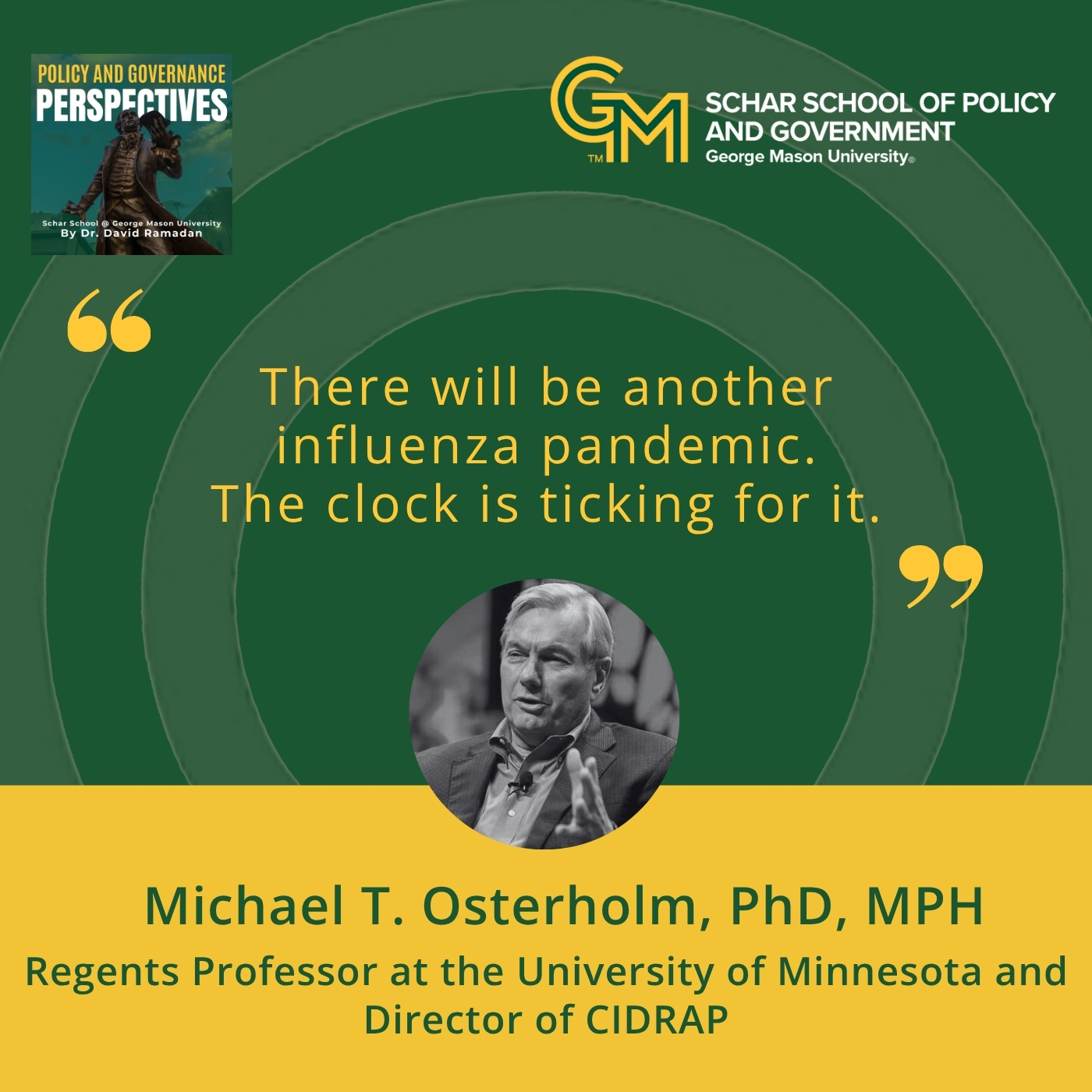
Let me start out by saying, first of all, there is going to be another influenza pandemic. The pandemic clock is ticking for it. We just do not know what time it is. Will it be H5N1? I am not sure. In fact, a year ago, when the outbreaks first occurred in the dairy operations around the country was one of those, how should I say it? Let us be careful here about predicting that this is going to be the next pandemic.
I have been involved with H5N1 dating back to the early 2000s time period. I was in Malaysia. I was in Indonesia. I was in Thailand, where the heart of the outbreak had occurred. I was certain at that time that we were going to see an H5 pandemic. It was going to be horrible. Nothing happened. We get to the 2008 to 2010 time period. Now we are starting to talk more about how the virus is changing, though.
Even though the case numbers were way down. I can tell you with exact clarity by the moment what it was like to be in a room at NIH in 2012 when two leading flu researchers came to the NSAVB and presented data saying we are simply one mutation away from a pandemic virus. You could have felt the tension in the room. You could have cut it with a knife. Nothing happened.
We get to 2015, and we see this big increase in cases that is occurring in Africa in the Nile River Valley among duck farmers. The largest outbreaks we have seen overall have been more fatal cases than we have seen in Asia. What happened two years later? It disappeared. We have had these experiences. We had 2015 H5N1 in poultry in this country when it first started moving to migratory birds.
There is something about this virus that I am not sure will ever be capable of becoming a sustained human pathogen pandemic virus. It does not mean it will not. I cannot say it will not, but I am not sure that it is. I think the fact that we do not see the ongoing person-to-person transmission with this virus, even when we do get infected with the eye, that type of thing, always sees very seriously ill cases.
We just had a young child die in Mexico last week with H5N1. These cases occur, but will a virus sustain itself? I do not know. Let me just come back to the fact that there will be another influenza virus that will cause a pandemic, and we need to know it. All I can say is I wish I knew now what I will know one day when that virus finally arrives. I will say, “That is what it was.” I do not know how to answer that beyond that, but I am not one of those who believe necessarily that H5N1 will be the next pandemic virus.
How To Address The Massive Threat Of Infodemic
In your book, you talk about the infodemic, that flood of accurate information, misinformation, and outright lies that accompanies the real disease epidemic. I know from personal experience that countering this information is very challenging. It is very labor-intensive. It seems like every time you debunk one rumor or false allegation, two more pop up. I am wondering what advice you have for scientists and public health workers who are working to try and contain the infodemic during the actual outbreak?
Let us all agree that a lie can travel around the world twice before the truth gets out of bed. That is a challenge. We are trying to study that and understand that at CIDRAP. I actually have an activity formally right now, looking at social media. Looking at different ways that different age groups, different ethnic groups get their information, and how they process it.
A lie can travel around the world twice before the truth gets out of bed.
Where do they go for validation of their information? Is it the Internet? Is it the medical community? Is it friends and family? What does that mean in terms of them? How do they validate that information? I can tell you as somebody who is an old timer who has now done over 200 podcasts, often lasting an hour. The average age of our audience is probably in their 60s. That is not the childbearing age population.
We have to understand that in the younger age population, the 16 to 35-year-olds, you need to be able to deliver a message in less than two minutes. You need to do it in fewer than 300 words. You've got to understand who the people are that are the validators in the community. We are trying to understand that so that we can do a better job of actually getting information. I can just give you one very real lesson that we have learned. Never preach or get into an argument with people like this because that will lay a foam off. It really is important that we are able to communicate with them.
How To Prevent Preparedness From Becoming A Political Casualty
We’re getting to the end of our show, Michael. How do we prevent preparedness from becoming a political casualty again?
David, that is absolutely one of those issues I just mentioned. I wish I knew what I would know sometime in the future. I do not have a good answer. When the fundamental issue of whether a vaccine should exist or not is on the table, it is very hard to think about things of less pressing order than that. Who will do that? There was no outcry when that $500 million was taken away from the vaccine research to develop better and more timely influenza vaccines.
No outcry at all. The challenge we have is that we are so immersed in just the survival of public health. I look at the CDC and FDA. They are shells of what they once were. The leadership of both those organizations is largely politically appointed individuals with very limited health experience or public health experience. We are just fighting for those programs to maintain themselves. This is hard.
Your point is really important. We have got to do it. There is an old oil frame commercial from the 1950s that used to say, “You can pay me now or you will pay me later.” This is a classic example of that very thing. We have to keep doing it. People often ask me, “At my age, why don't you just go retire?”
The book, The Big One, was a love story for me. It was a love story. It was a story for my kids and my grandkids is about the world that I want to see different than what the world is right now for those kids and grandkids. Most people might be surprised to know that we provide a lot of solutions in that book that could take pandemics off the table as catastrophic. They still emerge, but we could have such a major impact on them.
We could do so much more to provide a safer world from these emerging viruses. At this point, I do not know what it is going to take. I can tell you the mere fact that I sit at my desk right now, and sitting right over here is an eighteen-inch picture frame that every 30 seconds flashes a new picture of one of my grandkids or grandkids together. When I have a boring Zoom meeting, I am never bored. All I have to do is watch that screen, and it reminds me every hour of the day why I do what I do. As long as those kids and those grandkids are not safe, I am not done.
How Young People Can Be Part Of The Change
Thank you for doing what you do, Michael. Since we are a college or a university and the Schar School, I know you are going to be chatting with many of our students tomorrow. We are recording on the eleventh. This is not going to play for another couple of weeks. I know by the time this is out on air, you will have chatted with some of our students. For those who are preparing for careers in public service or global health who are not going to get a chance to talk to you directly during your fireside chat with our students, what advice would you give them?

Do not give up right now. There are a lot of headwinds in so many areas of higher education, not just public service or public health. The bottom line is that there will be a new day ahead. Higher education will be valued. The challenges we are going to have are still going to be there to fight the bugs. I want to remind everybody that one very sobering fact is that if you look at the last century, more people in this country have died from microbes than have died from all the bombs and bullets combined.
We have to remind people that the enemy of Mother Nature and those bugs is every bit as severe as a foreign actor. We would not for a moment think about diminishing or relinquishing our overall ability to respond to a foreign actor. Our problem is that we have not figured out why we should be responding to these microbes. I believe that future generations may have that opportunity. There may be a Renaissance. I remind people often that out of the darkness often comes light.
Many people do not realize that the Gutenberg Bible actually came as a direct result of the plague that hit the Middle Ages and killed so many monks who wrote the Bibles by hand. They needed a way to have a mass production of a Bible. The Gutenberg press came out of it. I go through a long list of crises that happened, but that ultimately resulted in good things. I believe that will be the case here. Students be part of that, be part of the change, be part of the effort. Know that it will not only be for your own benefit, but for the whole world. What an incredible way to live a life.
Students can be part of the change. Their efforts will not be for their own benefit only, but for the whole world.
We are almost out of time. Any final thoughts, Dr. Osterholm or Dr. Koblentz?
I want to thank Dr. Osterholm for that optimistic message. That is certainly something that we need our students to hear since we are training the next generation of students who are going to be working on these issues and trying to bridge that gap between the public health, scientific, and national security communities. While your book is definitely a sobering read, I think you do provide a roadmap for the future of how we can be prepared for the next pandemic and try and make sure it is not as bad as what we have already experienced. Thank you again for your service and for your book. Look forward to hearing more from you in the coming days.
Thank you, David. Thank you to you, Greg, for having me. I appreciate it. I hope most of all that anyone tuning in to this may come away with the idea. There is something we can do about it.
Episode Wrap-Up And Closing Words
Michael, thank you for your time and your work. Gregory, thank you for co-hosting this important conversation. Audience, you can find Dr. Osterholm's new book, The Big One, wherever books are sold. You can catch all of our podcast episodes at Schar.GMU.edu/podcast or wherever you get your podcasts. I am David Ramadan. This has been Policy and Governance Perspectives. Until next time, stay informed and stay ready. Thank you all.
Important Links
- Dr. Michael Osterholm on X
- Dr. Gregory Koblentz on LinkedIn
- The Big One: How We Must Prepare for Future Deadly Pandemics
- Living Terrors: What America Needs to Know to Survive the Coming Bioterrorist Catastrophe
- Deadliest Enemy: Our War Against Killer Germs
- Schar School of Policy and Government at George Mason University Podcast
- Vaccine Integrity Project
- Joe Rogan's Podcast on Spotify
- CIDRAP
Note from co-host Gregory Koblentz:
“As I mentioned, one of my Biodefense MS students, Shreya Rajkumar, wrote a review of The Big One in the Biodefense Program's weekly student-run newsletter, The Pandora Report.
The Pandora Report is no CIDRAP News, but we try to provide useful news and analysis of biodefense and global health security issues."
About Michael Osterholm

Michael Osterholm, PhD, MPH, is Regents Professor, McKnight Presidential Endowed Chair in Public Health, the director of the Center for Infectious Disease Research and Policy (CIDRAP), Distinguished Teaching Professor in the Division of Environmental Health Sciences, School of Public Health, a professor in the Technological Leadership Institute, College of Science and Engineering, and an adjunct professor in the Medical School, all at the University of Minnesota.
In early 2025, Dr. Osterholm and colleagues founded the Vaccine Integrity Project, a key initiative dedicated to safeguarding vaccine use in the US. He is also author of the new book, The Big One: How We Must Prepare for Future Deadly Pandemics.
In November 2020, Dr. Osterholm was appointed to President-elect Joe Biden's COVID-19 transition advisory board. From June 2018 through May 2019, he served as a Science Envoy for Health Security on behalf of the US Department of State. He is also on the Luther College Board of Regents.
He is the author of two additional, New York Times best-selling, books, In 2000, he authored Living Terrors: What American Needs to Know to Survive the Coming Bioterrorist Catastrophe, laying why the biological attacks (like the 2001 anthrax attack) are a new reality and what we must do to prepare, and his 2017 book, Deadliest Enemy: Our War Against Killer Germs, details the most pressing infectious disease threats of our day (including coronaviruses and pandemics) but lays out a strategy to address them.
In addition, Dr. Osterholm is a member of the National Academy of Medicine (NAM) and the Council of Foreign Relations. In June 2005 Dr. Osterholm was appointed by Michael Leavitt, Secretary of the Department of Health and Human Services (HHS), to the newly established National Science Advisory Board on Biosecurity. In July 2008, he was named to the University of Minnesota Academic Health Center’s Academy of Excellence in Health Research. In October 2008, he was appointed to the World Economic Forum Working Group on Pandemics.
In addition to his role at CIDRAP, Dr. Osterholm has also served as an HHS special advisor and a representative on the interim management team to lead the Centers for Disease Control (CDC) and Prevention. Previously, Dr. Osterholm served from 1975 to 1999 at the Minnesota Department of Health, the last 15 as state epidemiologist.
He has written more than 315 papers and abstracts, including 21 book chapters and is a frequently invited guest lecturer on the topic of epidemiology of infectious diseases. He serves on the editorial boards of nine journals.
Dr. Osterholm has received numerous honors, including an honorary doctorate from Luther College; the Pump Handle Award, CSTE; the Charles C. Shepard Science Award, CDC; the Harvey W. Wiley Medal, FDA; the Squibb Award, IDSA; Distinguished University Teaching Professor, UMN; and the Wade Hampton Frost Leadership Award, APHA. He also has been the recipient of six major research awards from the NIH and the CDC.
About Gregory Koblentz

Gregory D. Koblentz is an associate professor and director of the Biodefense Graduate Program at George Mason University's Schar School of Policy and Government. The Biodefense Graduate Program is a multidisciplinary research and education program designed to prepare students to work on issues at the nexus of health, science, and security, and bridge the gap between science and policy.
He is also the editor-in-chief of The Pandora Report, an online newsletter that covers global health security, and codirector of the Global BioLabs Initiative that tracks high containment labs and biorisk management policies around the world.
Koblentz is an associate faculty at the Center for Security Policy Studies at George Mason. He is a member of the Scientist Working Group on Biological and Chemical Security at the Center for Arms Control and Non-Proliferation in Washington, D.C., and the Security Working Group of the Engineering Biology Research Consortium (EBRC). In 2016, he briefed the United Nations Security Council on the impact of emerging technologies on the threat posed by nonstate actors armed with weapons of mass destruction. He serves as a pro bono advisor for the Open Society Justice Initiative, as a consultant for the Stimson Center on their cheminformatics program, and is a member of the Biothreat Advisory Board of Nighthawk Biosciences.
Prior to arriving at George Mason, Koblentz was a visiting assistant professor in the School of Foreign Service and Department of Government at Georgetown University. He has also worked for the Executive Session on Domestic Preparedness at the Harvard Kennedy School and the Nuclear Non-Proliferation Project at the Carnegie Endowment for International Peace.
Koblentz is the author of Strategic Stability in the Second Nuclear Age (Council on Foreign Relations, 2014) and Living Weapons: Biological Warfare and International Security (Cornell University Press, 2009) and coauthor of Global Biolabs Report 2023 (2023), Mapping Maximum Biological Containment Labs Globally (2021), Editing Biosecurity: Needs and Strategies for Governing Genome Editing (2018), and Tracking Nuclear Proliferation: A Guide in Maps and Charts (Carnegie Endowment for International Peace, 1998).
His research and teaching focus on understanding the causes and consequences of the proliferation of nuclear, biological, and chemical weapons to state and nonstate actors, global biorisk management, and the impact of emerging technologies on international security.
He received a PhD in political science from the Massachusetts Institute of Technology and an MPP from the Harvard Kennedy School.