
In This Story
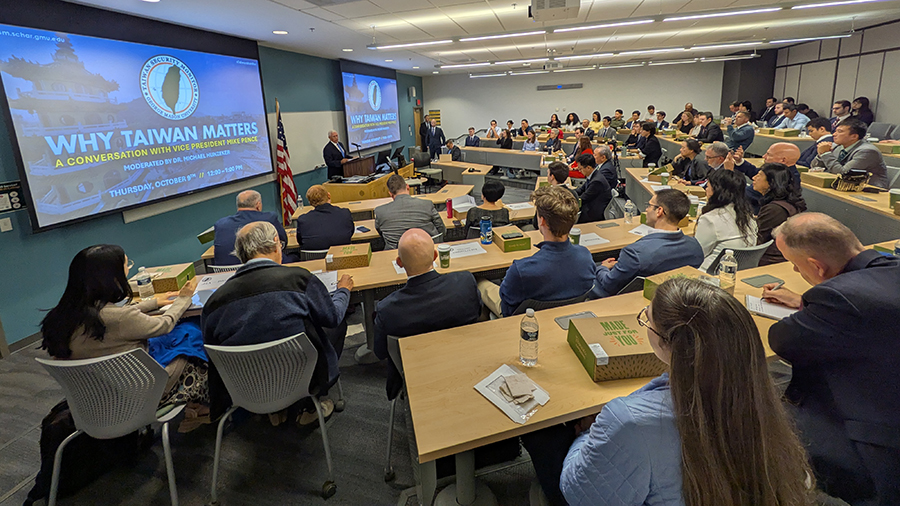
The room was filled to capacity on Thursday, October 9, as Vice President Mike Pence, Schar School Distinguished Professor of Practice, joined Mike Hunzeker, Schar School of Policy and Government associate professor and director of the Taiwan Security Monitor (TSM), for a discussion titled “Why Taiwan Matters: A Conversation with Mike Pence.” The lunchtime event, sponsored by the TSM, drew students, faculty, and members of the diplomatic community, including Ambassador of Taiwan to the United States Alexander Yui, who attended as an honored guest.
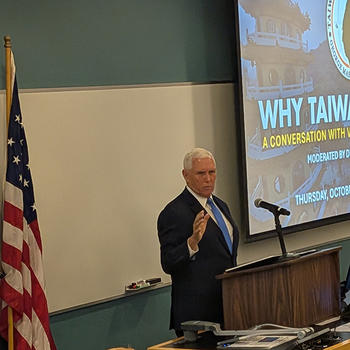
“Vice President Pence has been a consistent and vocal champion of Taiwan,” Hunzeker said in his introduction. “His experience gives him a unique perspective on why Taiwan’s security and prosperity matter—not just to Asia, but to the world.”
Pence Frames Taiwan as a Symbol of Freedom
In his opening remarks, Pence spoke at length about his long-standing support for Taiwan, describing it as “one of the most inspiring stories of any society in the 21st century.” Drawing on his visit to Taipei earlier this year, he praised the nation’s “resilience” and “commitment to liberty,” describing Taiwan as “a beacon of freedom shining across the Pacific.”
He emphasized what he called the strategic, moral, and economic stakes of supporting Taiwan’s defense, warning that failure to deter aggression from Beijing could embolden authoritarian powers worldwide. Pence called for the United States to accelerate a $20 billion backlog in arms sales to Taiwan, arguing that America is the “arsenal of democracy”—and that “peace comes through strength.”
While his remarks centered on Taiwan’s democratic achievements, they also reflected his broader view of American strength as the foundation of global stability.
Domestic Themes Abroad
Responding to a question often posed by students—why Taiwan should matter when the United States faces challenges at home—Pence linked foreign policy priorities to domestic concerns.
“I understand the frustration some Americans feel after long conflicts and challenges here at home,” he said, citing border security and economic uncertainty. “But anyone who thinks we can’t secure our own borders and still lead the free world has too small a view of the greatest nation on Earth.”
Pence praised the Trump administration for tougher border policies and increased defense spending. “The progress that we've made in turning the country back in the direction of security and prosperity has been heartening to me.” His remarks drew parallels between domestic security and international leadership, suggesting that both were essential to preserving America’s global influence.
“We can solve our problems at home while leading abroad,” Pence said. “That’s what America has done for generations, and it’s what we must continue to do.”
Faith as a Guiding Principle
At several points during the conversation, Pence connected his worldview to his religious faith, describing himself as “a Bible-believing Christian.” He reflected on the growth of religious communities in Asia, noting that he was “heartened to learn there are now more Evangelical Christians in China than there are members of the Chinese Communist Party.”
The comment illustrated how Pence’s perspective on democracy and freedom is shaped not only by political expertise but also by moral and spiritual belief.
In the discussion moderated by Hunzeker, Pence revisited the principle that “peace comes through strength,” asserting that any perception of wavering U.S. commitment could cause allies such as Japan, South Korea, and Australia to question their own security strategies.
“The stakes are enormous,” he said. “If America is not leading the free world, the free world is not being led.”
Pence’s comments emphasized confidence in American leadership and a belief that moral clarity remains central to international stability. His discussion of faith and freedom highlighted a recurring theme in his public life—the idea that America’s strength abroad is inseparable from its moral and spiritual foundation.
Emphasis on Strength and Resilience
During the audience Q&A, participants raised questions about supply chain security, rare earth minerals, and U.S.–China economic relations. Pence advocated for “economic freedom as the surest path to prosperity,” calling for lower taxes, reduced regulation, and expanded trade “with free nations like Taiwan.”
The discussion touched on complex regional issues, but Pence consistently returned to themes of national strength, deterrence, and moral purpose. His framing of American leadership reflected the belief that maintaining military readiness and projecting confidence abroad remain central to global peace.
Closing Reflections
Throughout the event, Pence reinforced his conviction that freedom must be actively defended. “Freedom is not guaranteed,” he said. “It endures because freedom-loving people stand without apology for the free people of the world.”
For the Schar School community, the conversation offered a chance to hear a former vice president’s vision of leadership in a changing global order—and to consider how questions of power, faith, and diplomacy continue to shape America’s engagement with the world.